Politics, open government, and safe streets. And the constant incursion of cycling.

Category: Society Page 64 of 69

Gov. Kaine Delays an Execution

The execution of Percy Walton has been stayed for 18 months, under an order from Gov. Tim Kaine, who explained that:

I am compelled to conclude that Walton is severely mentally impaired and meets the Supreme Court’s definition of mental incompetence. Because one cannot reasonably conclude that Walton is fully aware of the punishment he is about to suffer and why he is to suffer it, his execution cannot proceed at this time.

At the same time, it is within the realm of possibility – though unlikely – that Walton’s mental impairment is not permanent. Accordingly, a commutation of his sentence is not appropriate at this time. Rather, continued observation of Walton’s condition over a more extended period of time is the appropriate course of action.

As Vivian Paige rightly notes, pro-death penalty activists will probably slam Kaine for this. I think that Kaine ought to be commended for ignoring the usual public thirst for blood and taking a solid step towards determining whether or not Walton truly is capable of understanding his punishment. I, of course, would rather see the death sentence commuted (I am against the death penalty in all matters), but I think this is a good step, both in the moral and political senses.

For more on this case, and Virginia’s death penalty in general, see Virginians for Alternatives to the Death Penalty.

The Files

I spent a fair part of my early years living quite near the Iron Curtain. My childhood included more than the usual fun of bike rides and playing in the woods – it also included tanks rolling through the street in front of my house, calls in the middle of the night that had my father disappearing for weeks, and planning where I would hide out when the Soviets came.

On one of our school field trips, we went to Observation Point Alpha. We were told that if we stepped past the chain fence, we might get shot. Not a chainlink fence, but these little white posts connected by a single white chain. In retrospect, it was clearly an exaggeration by our guide, but most everyone in my class was aware of all the people that were shot trying to escape East Germany. If they would shoot their own people, they’d most certainly shoot us. When it was my turn to look through the binoculars, I wanted to see the faces of the people who would do that. It was hard to get a good view, but what I did see was this:

they looked just like us.

This is no great observation today, but do you remember what it was like, then? The awful evil scary Communists, lurking around every corner, waiting to kill us all? They looked just like us. It’s hard to describe just how much my world view has been shaped because of that field trip. Not necessarily because of what I saw and felt that day, but because what I saw and felt that day has moved me to question what I’ve been told, and keep asking questions, until I am satisfied.

One of the questions I asked, not so long after that, was of my German teacher, Herr Schmitt. Most of my American teachers would give slight variations on the same pat answer when I asked them about East Germany – “It’s a communist country, and communists are bad. They don’t believe in freedom.” Well, that’s fine, but what does that mean? That was a question that Herr Schmitt, alive when the walls went up and the curtains came down, was willing to answer.

East Germany was a very sad place, he said, because everyone was afraid. They were afraid of Americans, afraid of the Soviets, and afraid of each other. You couldn’t do anything in East Germany without someone knowing about it. If you did something someone thought the government would not approve of, they would tell on you, and it would go in your file. They keep files on normal people, like you and me. And those files are how the government watched people. If someone said or did too many things that the government didn’t like, the Stasi would come and throw them in jail, and their families would never hear from them again.

I don’t recall being entirely convinced, at the time. I mean, how could someone just disappear like that, without the family and everyone else doing something about it? And keeping records on everyone like that? Just seemed silly. Obviously, I didn’t understand.

What got me thinking and writing about this today? This:

[M]illions of Americans and foreigners crossing U.S. borders in the past four years have been assigned scores generated by U.S. government computers rating the risk that the travelers are terrorists or criminals.

[ . . . ]

Virtually every person entering and leaving the United States by air, sea or land is scored by the Homeland Security Department’s Automated Targeting System, or ATS. The scores are based on ATS’ analysis of their travel records and other data, including items such as where they are from, how they paid for tickets, their motor vehicle records, past one-way travel, seating preference and what kind of meal they ordered.

Even better?

The travelers are not allowed to see or directly challenge these risk assessments, which the government intends to keep on file for 40 years.

It all feels . . . distantly familiar.

The N-word

Read this.

(Personally, I’ve shied away from using it, thinking it mostly unhelpful. Ms. McWhorter gives me good reason to reconsider.)

Update: Lest you be tempted to skip it, take note of this paragraph:

We have become such “good Americans” that we no longer have the moral imagination to picture what it might be like to be in a bureaucratic category that voids our human rights, be it “enemy combatant” or “illegal immigrant.” Thus, in the week before the election, hardly a ripple answered the latest decree from the Bush administration: Detainees held in CIA prisons were forbidden from telling their lawyers what methods of interrogation were used on them, presumably so they wouldn’t give away any of the top-secret torture methods that we don’t use. Cautiously, I look back on that as the crystallizing moment of Bushworld: tautological as a Gilbert and Sullivan libretto, absurd as a Marx Brothers movie, and scary as a Kafka novel.

I well and truly hope she is wrong on that – if America “no longer ha[s] the moral imagination to picture what it might be like to be in a bureaucratic category that voids our human rights”, then my America is no more. And while I admit that, at various points in the past few years, I have been near sure that that is true, I am not yet ready to accept it.

Sunday Reading

Meet the real weapon of mass destruction:

The AK-47 has become the world’s most prolific and effective combat weapon, a device so cheap and simple that it can be bought in many countries for less than the cost of a live chicken. Depicted on the flag and currency of several countries, waved by guerrillas and rebels everywhere, the AK is responsible for about a quarter-million deaths every year.

I have no idea as to what can be done about it. It is very much a genie that was let out of a bottle.

~

So, the National Science Teachers Association isn’t interested in 50,000 free copies of An Inconvenient Truth. Well, I thought that a shame, but did give some credibility to their response, which said that “In their e-mail rejection, they expressed concern that other “special interests” might ask to distribute materials, too; they said they didn’t want to offer “political” endorsement of the film”. Ah, okay. And then I read further:

But there was one more curious argument in the e-mail: Accepting the DVDs, they wrote, would place “unnecessary risk upon the [NSTA] capital campaign, especially certain targeted supporters.” One of those supporters, it turns out, is the Exxon Mobil Corp.

That’s the same Exxon Mobil that for more than a decade has done everything possible to muddle public understanding of global warming and stifle any serious effort to solve it.

Fantastic job, guys.

~

Looking for good holiday gifts? Check out Make. I’m a subscriber, and a huge fan.

~

And in the “Hmm, there must be more” news, the UK seems to be declining to extend its 50 year copyright term to 95 years. It’s a shocking bit of good sense. We’ll see whether that remains in place. The real test will come in 2012, when the first Beatles recordings bump up against the 50 year term.

Who will survive today?


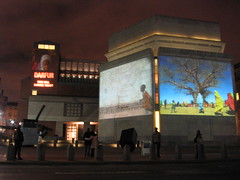
The US Holocaust Museum is bearing public witness to what is happening in Darfur. Every night, through this Sunday, images from one genocide are projected on the walls of a building dedicated to another. If you’re in the area, you should stop by and see it. Runs from 5:30 until midnight.

Exporting Absurdity

The far-right, as based in the United States, has generally stepped up its efforts to export its ideology and policy abominations to the rest of the world (recall the teams of flat-taxers that descended upon eastern Europe in the early 90s, or the NRA’s latest efforts to make sure that anyone can have a gun anywhere).  This NY Times article gives us another example, of a Mr. Shikwati, a:

young teacher in western Kenya when he came across an article by Mr. Reed on the genius of capitalism. In this isolated village where Mr. Shikwati was raised, life revolved around mud huts and maize, not smokestacks. Still he dashed off a note to Midland, Mich., where Mr. Reed runs a think tank that promotes conservative economics and offers a program teaching others to do the same.

Ah, yes.  Just send a self-addressed, stamped envelope, and I’ll send you my materials, which will teach you how to get rich, rich, rich!  To be honest, though, it sounds like Mr. Reed has been generous enough to pick up the up-front costs:

Over the next four years, Mr. Reed sent books, reports, magazines, tracts — even occasional sums of money — as Mr. Shikwati embraced capitalist theory with a passion.

But nothing is free, right?  Especially when it comes to capitalism.  Perhaps you can see the future costs here:

On a continent where socialists have often held sway, Mr. Shikwati is now a conservative phenomenon. He has published scores of articles hailing business as Africa’s salvation; offered free-market lectures on five continents; and, defying the zeitgeist of the Bono age, issued scathing attacks on foreign assistance, which he blames for Africa’s poverty. When Western countries pledged to double African aid last year, an interview with an angry Mr. Shikwati filled two pages of Der Spiegel, the German magazine.

“For God’s sake, please stop the aid!” he told the magazine.

Now, I’m no socialist.  And I do think that, in the end, African countries would be better off with more open markets than most of them have right now.  But it’s a hell of a long way between here and there.  And to see these free market fanatics – who’s ideas can’t even work in developed Western countries – descend upon the rest of the world in an effort to sow the seeds of their idiocy (and, to be sure, their own great profit, should anything ever come of it) is just appalling.   Now, the free market conservative movement generally a patient one – they’ve been bankrolling American ideological institutions for decades, in a slow roll approach to shifting the cultural and political norms in the US.  But they’re not unwilling to take short term gains where they can.  Now guess what they’re getting out of Mr. Shikwati?

[N]ine months after he started his group, Western supporters flew him to the United States, where he joined a dinner of the conservative Heritage Foundation and toasted an A-list crowd that included Edwin Meese III, the former attorney general.

I guess J.C. Watts was busy.  Okay, I should probably have skipped the easy joke about how far Republicans are apparently willing to go to find a little color for their party.  Now take a look at the more serious consequences:

With no academic credentials, Mr. Shikwati made a mark as an author of opinion articles. He defended McDonald’s against critics of globalization and drug companies against charges of price gouging. He called for the legalization of the ivory trade, which he argues would protect elephant herds. Above all, he called for an end to foreign aid, saying it hurt local markets, corrupted governments and promoted dependency.

There’s the immediate payoff.  Add a local face and voice to nod and agree with your absurd no tax, no regulation, free market plans for a place that can’t yet manage basic education, roads, or utilities, and the Western press will treat it as credible.  Note:

His iconoclasm and his authenticity as an African made Mr. Shikwati attractive to the Western press, despite his lack of prominence at home. His views quickly traveled the globe, appearing in places as diverse as The Sydney Morning Herald, The Jerusalem Post, The Times of London, Forbes and The Washington Post.

Echoing his calls to end foreign aid, Suzanne Fields of The Washington Times lauded Mr. Shikwati, who has a bachelor’s degree in education and no economics training, as nothing less than “a distinguished Kenyan economist.”

Maybe that’s the real American export, here – a trademark conservative method of claiming ideology as fact, by carefully packaging and repeating it.  Buyer beware.

CNN’s finest

Media Matters brings us this gem:

On the November 14 edition of his CNN Headline News program, Glenn Beck interviewed Rep.-elect Keith Ellison (D-MN), who became the first Muslim ever elected to Congress on November 7, and asked Ellison if he could “have five minutes here where we’re just politically incorrect and I play the cards up on the table.” After Ellison agreed, Beck said: “I have been nervous about this interview with you, because what I feel like saying is, ‘Sir, prove to me that you are not working with our enemies.’ ” Beck added: “I’m not accusing you of being an enemy, but that’s the way I feel, and I think a lot of Americans will feel that way.”

And to think that CNN is supposedly the left-leaning network . . .

MLK, Jr. Memorial Groundbreaking – Part II

(This is the second part, which follows this. A word about the quotes in the body of the post – I have done my best to be accurate with these quotes, but please don’t take them as a certainty.  Where there has been a transcript to check them against, I’ve done so.  Where there has not, I’ve only used quote marks were I am quite sure, but cannot be certain.  Thanks.)


Let us realize the arc of the moral universe is long, but it bends toward justice.

-Dr. Martin Luther King, Jr.

Sen. Obama walked us through what he imagines the memorial will look like, with the mountain of despair at one end, and the at the other.  And then he took us to that moment that many of us can imagine – and want very much to get exactly right: one day, his daughter will ask, “Why is this here, daddy?  Who was this man?”  And he’ll have to answer.

I’ve not yet found a transcript of his speech, which is a shame, because his answer is one that we might all want to give.  He started out by saying that he’d have to point out that, unlike the other men honored on the Mall, King was no President.  No war hero.  In fact, while he was alive, he was reviled by at least as many, if not more than, those who praised him.   He would tell her that King was a man with flaws, sometimes filled with doubt.  But he would say that King is someone who answered his charge.  A man who carried his burden.  A man who – and this is the line that really stuck with me – “tried to love somebody.”

Imagine that.  A monument on the Mall to a man who simply tried to love somebody.

~

Byron Cage, well backed by Ft. Washington’s Ebenezer AME Church Choir, took the stage again.  After this performance, the chairman of the Congressional Black Caucus, Rep. Mel Watt (D-NC) spoke briefly about his own experience meeting Dr. King, which started him down a path from that segregated high school to the halls of the U.S. Capitol building.   He also made a point of thanking Connie Morella (former representative from Maryland, and current ambassador to the OECD.  Ms. Morella is the kind of Republican we’d all like to see more of, I think.)  Finally, he introduced the King children.

The “King children.”  Hardly children anymore, but that’s what they’ve been for all of their lives.  While they’ve always lived in the shadow of their father (and mother, for some of them), they’ve still developed distinctive public personas, which were clearly on display this morning.  Yolanda King went first, and . . .well, her speech was set to music.  Really.   She then introduced her brother, Martin Luther King, III.  He, in his usual quiet and gracious way, invited Dr. King’s sister – Denise King Farris – and her children and grandchildren up to join them.

Martin spoke on the importance of justice to his father’s legacy.  He did what no one else, in over a dozen speakers by that point, had done -  he called for realizing Dr. King’s dream: peace.  The only speaker besides Clinton to explicitly mention nonviolence, he reminded us that it is “more than a tactic, it is a way of life.”  Nonviolence is “a means whose end is community.”  He asked (perhaps to a President who was no longer around to listen), “What war has ever resulted in lasting peace?”  It was a question I can only hope lodged itself in the minds of the politicians and officials that sat around me.

Rev. Bernice King then stepped up, proving that she is, indeed, her father’s daughter.  Turning the podium into a pulpit, she praised her father as a great pastor, not to just to his congregation, but to the nation and the world.  She reminded us of his telling those around him that hate is too great a burden to bear, a reminder that I, in all honesty, have needed of late.  I suspect I’m not the only one.   Like her brother, she did not shy away from her father’s politics – decrying the “triple evils of racism, poverty and militarism” which “are clogging our arteries more today, than they were in his.”  That is no small statement.

[Dexter wasn’t there, and no explanation was offered, though he was on the original program.]

Dr. Dorothy Height
then graced us with her presence.  Bringing her 94 years of perspective and context to the table, she talked about the importance of making sure that others honor Dr. King’s legacy with the perspective and context it deserves.  The memorial is still not fully funded, and she encouraged us to give – for the past, present, and future.  Give for all of us.

As she finished, Rep. Lewis took the stage again, telling us about his relationship with Dr. King – as a leader, a hero, a colleague, a friend.  He told us that, of the ten speakers on the steps of the Lincoln Memorial where Dr. King delivered his most famous speech, he is the only one left.  As he brought the stage ceremony to a close, he left us with these words:

“That is why I think it is so fitting, so appropriate that on this sacred and hallowed ground, a memorial will be built not only to an American citizen, but to a citizen of the world who gave his life trying to protect the dignity of and the worth of all humankind.

“I want to thank Alpha Phi Alpha for its vision and thank all of those contributors who supported this project, because this monument will inspire generations yet unborn to get in the way. It will help them see that one human being can make a difference.

“But above all, this monument will serve as a reminder to each of us that it is better to love and not to hate, it is better to reconcile and not divide, it is better to build and not tear down.

“It will remind all of us that the dream of Martin Luther King Jr. is not yet accomplished, and each of us must continue to do our part to help build the Beloved Community, a nation and a world at peace with itself.

The stage guests, along with much of the crowd, then moved to a spot closer to the edge of the Tidal Basin for the ceremonial groundbreaking.  Dr. Height, pushed by John Lewis, Andy Young, and Jesse Jackson, led the way.  Jack Kemp then spoke, calling on Congress and the President to honor King’s legacy by granting full voting rights to DC citizens.  He then gave way to two men who were with Dr. King at the Lorraine Motel the day he was murdered.

Jesse Jackson asked us to remember him by challenging power with truth.  To “disturb the comfortable, while comforting the disturbed.”  Both men spoke of their last hours with Dr. King.  Andrew Young’s recollection was the final, and the most powerful.  He said that King had chastised them that day for not doing enough to get the message out themselves, saying that “you all have left me out here alone.”  At this point, he stopped briefly – in tears – and I think a wave of sadness passed through the crowd.  After a few moments he continued, repeating King’s words to him:

“Don’t let me down.”

Don’t let him down.

MLK, Jr. Memorial Groundbreaking

“I have a dream that one day this nation will rise up and live out the true meaning of its creed: ‘We hold these truths to be self-evident: that all men are created equal.”

-Martin Luther King, Jr. & Thomas Jefferson

Soon, the Tidal Basin will be home to memorials that honor both of the men who made this sentence – perhaps the greatest American quote of all time – possible. This morning, the Martin Luther King, Jr. Memorial Foundation broke ground on a project that has been decades in the making. First conceived at a Alpha Phi Alpha meeting in 1984, the Memorial should be complete in 2008. Situated on the northeast corner of the Tidal Basin, it will sit between the Lincoln and Jefferson memorials – a rare Mall monument to a man who was neither President nor war hero. Rather, it is a memorial for a man who reminded us that “everyone can be great, because everyone can serve.”

And serve Dr. King did. But you know that. Every American knows that. And if you don’t, well, I’ll leave that rich and amazing story to be told by someone better able than I. Instead, I’m just going to offer my own take on today – a very personal experience for me.

It was, to be sure, a very personal experience for almost everyone there. And that does not surprise me at all. Dr. King – even all these years later, even with people who weren’t even born when he was murdered – has an impact and reach that is almost impossible to describe. Today, Rep. John Lewis said, of hearing Dr. King’s voice on the radio when he was a 15 year old in Troy, Alabama, “when I heard his words: it felt like he was speaking directly to me. John Lewis, you can make a difference.” It is no less true for me, or – I suspect – anyone who has ever quietly listened to his words.

Depending on your age, or where you’re from, the civil rights struggle may seem less than personal for you. In my own case, circumstances of time and geography were such that I didn’t experience its most famous moments directly. I was fortunate, however, to have spent many of my formative years in the aura of many of its most significant actors. When I first moved to Atlanta, Andrew Young was its mayor. My first apartment was in the Vine City neighborhood, adjacent to Morris Brown and the rest of the Atlanta University Center (home to Morehouse, Spelman, Clark, and the Interdenominational Theological Center). For a while, at least, I shopped at the same West End grocery store as Jamil Abdullah Al-Amin (H. Rap Brown). Later, I lived and worked at the intersection of Peachtree St. and (Sweet) Auburn, chatting with Rep. Lewis in our office building’s elevators, or waiting with Julian Bond for our cars. Early in my career, I was part of the effort to make the Martin Luther King, Jr. Holiday a “day on, not a day off.” Through this, I frequently found myself in Mrs. King’s presence while working with Dexter King and other King Center staff. The list goes on and on. The point is, not only is the civil rights struggle itself very much alive, so are many of the people who did so much of the work early on. It isn’t history – it’s us. Here. Today.

Thus, it was the here and now that I thought about as I watched the dais assemble, and the speakers share their stories. Soledad O’Brien and Tavis Smiley were MC’ing the event, and I think that the entire crowd cringed when Soledad said, “I had a dream that it would not rain.” I hope we never fall so far as a society where that will ever be an acceptable punch line. Thankfully, Tavis quickly took over, setting the tone for the day by saying that he was proud to be a part of the day, as he would “rather have the living ideas of the dead, than the dead ideas of the living.”

Anthony Williams, outgoing mayor of DC, next welcomed the crowd. Williams, fairly or not, has never been thought of as a particularly powerful speaker, but he brought out great applause when he ended his speech with a call for District voting rights. The crowd itself was interesting. There were your expected politicians – right in front of me were Senators Arlen Specter and Paul Sarbanes, along with Reps. Bobby Scott and Sheila Jackson-Lee. There were also your unexpected – Larry Fishburne was quietly sitting nearby, and next to me were three young men who couldn’t have been older than 19 or 20 (as evidenced in no small part by their “Damn, this is *major*, yo.” when Smiley and O’Brien first came out – after, oh, John Lewis, Andy Young, and Maya Angelou had already come out. Major, indeed.). Andrew Young then took the stage, introducing Darryl Matthews (president of Alpha Phi Alpha, who pointed out that the memorial is still only 2/3rd of the way towards its fundraising goal) and Tommy Hilfiger (who’s purpose was lost on me, honestly). And then, well . . . Bill showed up.

President Clinton, as he always does, delivered a great speech. He looked both to the past and the future, with two things really standing out for me. Putting our moral present in the context of the past, Clinton recalled Jefferson’s saying that when he reflected on slavery, he trembled to think that God is just. For me, this brought home some of our own recent moral failures. But ever the optimist about human nature, he went on to say, of Dr. King, “If he were here, he would remind us that the time to do right remains.” Indeed, it does. And we should not waste a moment of it.
My brief moment of sharing that optimism was quickly brought back to earth, as Attorney General Alberto Gonzales scurried in late, taking a seat near by. I doubt he would have understood the words, even if he’d heard them. In fact, in the spirit of turning the other cheek, I’m simply going to say that, shortly after the next speech (Oprah’s, which was very good), President Bush arrived and gave his speech. My only observation is that Bush would know that there is no such place as “Sweet Auburn, Georgia,” if he’d visited Dr. King’s tomb more than once. More coverage of Bush’s speech here.)

After Bush’s departure, Diane Sawyer read us a letter from perhaps the only living person who can even begin to approach the moral leadership that King gave us – Nelson Mandela. Maya Angelou then asked us to “look where we’ve all come from.” After a pause, Tavis Smiley introduced the next speaker as “someone who has recently sold a few books, a United States Senator, and maybe just maybe . . . ,” cracking a knowing grin, “ahhh, nevermind.” And Barack Obama, of course, came to the podium. The welcome that greeted him was the biggest of the morning, greater than even President Clinton’s or Oprah’s.

[Part II forthcoming]

Morning in DC

Worthy neighbors

A memorial to Thomas Jefferson – the man who penned the words "We hold these truths to be self-evident: that all men are created equal", will soon be joined by a memorial to a man who built upon those words, saying "I have a dream that one day this nation will rise up and live out the true meaning of its creed: ‘We hold these truths to be self-evident: that all men are created equal."

This morning, I was lucky enough to attend the groundbreaking for the Martin Luther King, Jr. Memorial. It was an amazing gathering, which I will say more about later this evening. In the meantime, here are some pictures and notes from the morning.

Page 64 of 69

Powered by WordPress & Theme by Anders Norén