
Politics, open government, and safe streets. And the constant incursion of cycling.

Category: Law Page 23 of 27

Friday Notes: Reviewing the Basics

Josh Marshall asks an obvious question about the validity of a bill that was signed by the President, but not passed by the House or Senate. Is there really a question here? And if so – was I’m Just a Bill on Capitol Hill all a pack of lies?

Speaking of having to concern ourselves with things that ought not to have occurred in the first place, you’ve probably heard about the problem with Pearl Jam’s webcast performance this past Sunday. One of AT&T’s webcast editors apparently cut out parts of the performance that were critical of Bush (a few lines, it seems). AT&T is blaming an overzealous editor, and is claiming no nefarious intentions. Which I’m perfectly willing to believe. But it still leaves me asking: what kind of culture do we have where it makes sense to you – an editor covering a Lollapalooza concert, for godsake – to dump a few mildly critical lines about the President? Are you that afraid? That bitter? It makes no sense to me.

And in the category of things that make no sense, you might have seen the amusing video of CNBC financial show host Jim Cramer’s on-air meltdown. Actually, it was only amusing if you didn’t listen to the details of what he was going on about. If you actually listened to him, it was really sort of nauseating. Short version: my free-market titans got too greedy trying to make money off of loans that never should have been made, so now we need the Fed to bail us out. Funny how that works, no? And even funnier is this annotated video of his meltdown, which details the sheer ridiculousness of it all.

~

And the Discovery Channel cycling team is dead.  Despite their having the most recent Tour de France winner, 8 TdF wins, and a solid roster of riders, they couldn’t come up with a sponsor.   Huh.
Heading out to see a movie? Skip Ballston’s Regal Cinema

This is ridiculous:

ARLINGTON, Va. – A 19-year-old woman is facing up to a year in jail and a fine up to $2,500 when she goes to trial this month on charges of illegally recording part of a motion picture.

Jhannet Sejas readily admits she used her digital camera last month in an Arlington theater to film about 20 seconds of the climax of the hit movie “Transformers.” She said she wanted to show the clip to her little brother and had no intention of selling it.

But minutes after filming the clip, police showed up in the theater, shining a flashlight in her face. Sejas and her boyfriend were ordered out, and the camera was confiscated.

Just an overzealous usher and bored police, right? Well:

Arlington County police spokesman John Lisle said the theater wanted to prosecute the case, which is a first for the police department.

“They were the victim in this case, and they felt strongly enough about it,” Lisle said.

That’s right. A crappy 20 second video clip victimizes Regal Entertainment Group (Second quarter 2007 gross revenues of $684 million). Another blow to the beleaguered forces of overbroad copyright claims. How will they ever survive?

This is the closest theater to me, and while it’s not my favorite in the area, I’ve often used it out of convenience. In fact, I’d made plans to see a movie there tonight. Forget it. For tonight and every other night. I’d urge you to do the same.* Better environments and movies can be found at Landmark’s E Street Cinema, Arlington Cinema and Draft House, or even the AMC Theatre in Courthouse.

Update: check out the WaPo story for additional details and some choice quotes. From the general counsel of the theater owners’ association: “We cannot educate theater managers to be judges and juries in what is acceptable[.]” Well, there you go.

*And let them know why.  You can contact Regal Entertainment Group corporate offices at:

7132 Regal Lane, Knoxville, Tennessee, 37918.
Corporate phone: 1-865-922-1123
Fax: 1-865-922-3188
Customer relations number: 1-877-TELLREGAL or 1-877-835-5734.

Dismantling Brown v. Board of Education: A Start in Understanding It

If you’re interested in understanding what actually happened in today’s Supreme Court decisions on school desegregation, I highly recommend reading this discussion at Slate.  It’s a conversation between three people.  First, there is Dahlia Lithwick, a reporter who regularly covers the Supreme Court.  I’ve grown from a detractor into a fan, over the years.  I think she does a good job of translating the language of the Court into something that is meaningful to the public at large.  Her regular partner in these discussions is Walter Dellinger, an actively practicing appellate lawyer with a resume that would make a Chief Justice blush.  I’ve always been terribly impressed with his explanations of Supreme Court decisions, and Slate is lucky to have such insightful analysis on its pages.  Finally, in the interests of balance, they’ve brought in Stuart Taylor, a conservative writer who generally concurred with the Court’s actions.  I think some of his analysis is a bit simplistic, but it’s an honest contribution to the conversation.  Do check it out.

Another Fine Legislative Achievement in Virginia

The wake-me-up-quicker-than-coffee moment this morning came courtesy of Del. Dave Albo, who gave rise to this gem of a law, which will become effective July 1st:

Driving as little as 15 MPH over the limit on an interstate highway now brings six license demerit points, a fine of up to $2500, up to one year in jail, and a new mandatory $1050 tax. The law also imposes an additional annual fee of up to $100 if a prior conviction leaves the motorist with a balance of eight demerit points, plus $75 for each additional point (up to $700 a year). The conviction in this example remains on the record for five years.

Ever driven 80mph on I-66 or 95? If so, you’re looking at not just a reckless driving conviction, but also $3550 in fines and taxes. It’s the sort of thing that makes you worried enough to get a lawyer to see if you can get that ticket knocked down a bit. And guess who’ll be there to help?

Albo, a senior partner in the Albo & Oblon, LLP traffic law firm, can expect to see a significant increase in business as motorists seek to protect their wallet from traffic tickets that come with assessments of up to $3000 in addition to an annual point tax that tops out at $700 a year for as long as the points remain.

WTF? Yes, Albo the legislator ginned up business for Albo the traffic lawyer. I guess we should be thankful he’s not a firefighter.

(Found this story via NLS, but it looks like Albo Must Go has been on the story a while. I’m sorry I didn’t notice it earlier.)

Update: The Washington Post has the story.

Bush and Cheney Set Standard for Acceptable Language

Okay, the title of this post isn’t really accurate at all. But lord, is this funny. In rejecting the FCC’s new enthusiasm for fining TV stations for broadcasting even a brief and unplanned use of an expletive, the Court of Appeals:

Adopt[ed] an argument made by lawyers for NBC, [and] cited examples in which Mr. Bush and Mr. Cheney had used the same language that would be penalized under the policy. Mr. Bush was caught on videotape last July using a common vulgarity that the commission finds objectionable in a conversation with Prime Minister Tony Blair of Britain. Three years ago, Mr. Cheney was widely reported to have muttered an angry obscene version of “get lost” to Senator Patrick Leahy on the floor of the United States Senate.

Fucking brilliant.

Cryptome Shutting Down?

Via Slashdot, I see that Verio recently sent Cryptome.org a notice informing the owner that Verio will no longer provide hosting services as of this Friday. What is Cryptome, and why should you care? Cryptome is perhaps the most impressive individual effort at plugging the “memory hole” that has ever existed.* In Cryptome’s own words:

Cryptome welcomes documents for publication that are prohibited by governments worldwide, in particular material on freedom of expression, privacy, cryptology, dual-use technologies, national security, intelligence, and secret governance — open, secret and classified documents — but not limited to those.

As you might imagine, this has annoyed not just the US government, but governments around the world. I’m near-fanatical when it comes to the idea that transparency is essential to good government, and I think James Young (who runs Cryptome) has done important work in advancing that idea. So getting this notice of shut down from Verio – with no explanation beyond a claim that Cryptome is violating its Acceptable Use Policy – is troubling. Verio, which has otherwise been an excellent host for Cryptome, appears to be unwilling to explain the reasons behind terminating this relationship. Mr. Young speculates:

It may be wondered if Verio was threatened by an undisclosable means, say by an National Security Letter or by a confidential legal document or by a novel attack not yet aired.

I should hope not. But that appears to be the most likely explanation.  I’d quite like to see more on what happened.

*I’m not absolutely certain, but I think Cryptome may be the first online effort I’ve ever donated to.

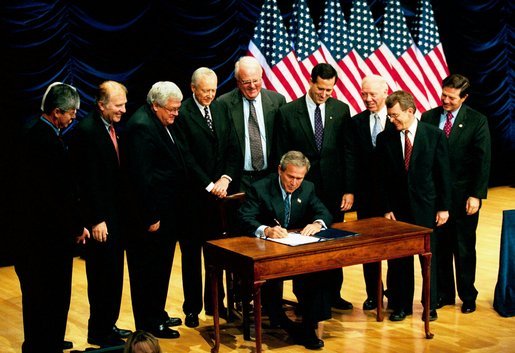
Five out of Nine Justices Agree: These Men Know What’s Best For Women

Signing of Partial Birth Abortion Ban

More here, if you can stand it.

DC Voting Rights: More of the Same

Oh, I could go on about the paragon of hypocrisy and duplicity that is the Bush White House, or tell you (once again) that for all of his other faults, Rep. Tom Davis (R-VA) is trying to do right by DC.  But I won’t.  Because it’s pointless.  And it just brings out all sorts of hateful things that I should let percolate for a while.  So I’ll direct you to DCist’s recent coverage of the issue, which has been surprisingly good.  See this for the coverage of today’s debate, and then this for where things appear to stand now.

Voter ID Requirements: Some Data

Voter ID requirements certainly get people excited. Democrats (mostly) fight them, arguing that they reduce access to the polls. Republicans fight for them, under the guise of reducing voter fraud. I’m coming to understand, however, that neither side really has any solid data to back their claims and theories up. So this Slate story covering the findings of a university consortium study on the matter (the Cooperative Congressional Election Study) makes for interesting reading. Some specific findings:

  • half of the survey respondents said they were required to present photo ID, even though in 2006 the laws in only Indiana and Florida required this of all voters
  • poll workers asked for such identification very frequently in the South (65 percent) and rarely in the Northeast (22 percent)
  • just 23 people in the entire sample—less than one-tenth of 1 percent of reported voters—said that they were asked for photo identification and were then not allowed to vote
  • African-Americans were asked to present photo ID more often than whites—54 percent of the time versus 46 percent

These are all interesting – if somewhat inconclusive – findings, and I recommend the whole article (and hey, Waldo, maybe you can put that Edward Tufte education to good use!). The author really draws only one conclusion at the end, one my experience as a volunteer voter protection attorney bears out:

To return to the finding that half of survey respondents said they were required to present photo ID despite the rarity of relevant state laws, this result is instructive because of what it suggests about how rules are not followed. Both sides of the voter-fraud debate assume that registration requirements matter because poll workers will apply them as instructed. In truth, this country continues to rely on barely trained volunteers to administer the actual process of voting. Any plan to combat fraud or increase access, let alone upgrade voting technology, must take into account that it will be administered largely by amateurs.

Something to consider next time we engage each other on this subject.

Popular Support for the Rule of Law . . . in Pakistan

It seems that things are heating up in Pakistan. Earlier this month, Gen. Pervez Musharraf suspended the Chief Justice of Pakistan’s Supreme Court, ostensibly for “misuse of authority.” However, as noted in this BBC piece, the Chief Justice has “a reputation for taking a firm line against government misdemeanours and human rights abuses.” As news of the Chief Justice’s removal spread, so did protests. Today, it was reported that:

Police in the Pakistani capital Islamabad on Friday used tear gas to clear the offices of the private Geo news channel as it broadcast live footage of clashes with protesters.

Windows were smashed in the lobby as officers tried to interrupt transmission of violent scenes near the Supreme Court, where suspended chief justice Iftikhar Chaudhry stood before a panel of judges over allegations of misuse of office.

Undoubtedly, some of the motivation behind the protests is political. Nawaz Sharif (former prime minister, deposed by Musharraf) and Benazir Bhutto (also former prime minister, lost (in a questionable election) to Sharif) are adept at stirring protests into action when it benefits them. But the discontent that has erupted in response to the Chief Justice’s removal seems to go far beyond business as usual. As the Washington Post reports:

“Nothing like this has happened during the time Musharraf has been in power,” said Ayaz Amir, a columnist for the English-language Dawn newspaper. “This has shaken the country. It has shaken the government. This is the most serious situation Musharraf has faced, and it has all the potential of getting out of hand and turning into something bigger.”

It may be strange to think of Pakistan – a country that generally welcomed its military dictator when he first took over – as being all that concerned with the rule of law. But that may well be what we have here.

Page 23 of 27

Powered by WordPress & Theme by Anders Norén