
A mostly painless and pleasant journey home. Unfortunately, I’ll need to spend most of the day sorting out the enormous mess that Earthlink’s blacklisting of my domain host company has created. As I feared, Earthlink has been bouncing almost all email that has been sent to me over the past couple of weeks. Out of country, no continuously reliable phone roaming service, and no email – perhaps an ideal vacation, but not if you want to have anything to come back to . . .
Category: Travel Page 26 of 29


On the road, exploring more of the world. Istanbul was amazing, Dubai was its usual outsized self, and Pakistan has been nothing short of wonderful. More words and pictures to come in the new year. Have a good one.
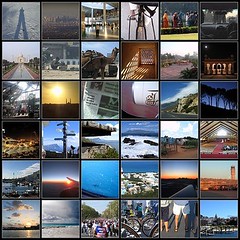
I’d had grand designs on 1000 words to go with each of these pictures, but time is not on my side. I expect to be heading offline in short order, and may not reappear before the new year. Perhaps I’ll have a few new pictures by then, and might have finished up a few of those 1000 word drafts.
Here’s to 2007.
(Photos: 1. Three Years, 2. A City, 3. JFK, 4. Still moving, 5. Outdressing the bride, 6. Traffic, Pt II, 7. Taj Mahal Reflecting Pool, 8. Fixing a Flat, 9. Easier than an elephant, 10. Zenana – window, 11. Mughal Sheraton – Agra, 12. Just missing, 13. The sun makes it in, 14. Call to prayer, 15. Welcome to the Middle East, 16. Something new, 17. Twelve Apostles, 18. Africa, 19. Port of Call, 20. I’m where?, 21. WWII Bunker, 22. Cape Town from Robben Island, 23. Soweto shantytown, 24. Regina Mundi, 25. Victoria Waterfront – Cape Town, 26. Sunset over the Black Sea, 27. Another point of reference, 28. St. Davids Lighthouse on approach to BDA, 29. Skyline, 30. National Airport at Dawn, 31. Bermuda Sunset, 32. But not entirely blue, 33. Liberty and Justice for All, 34. Can’t seem to escape the traffic, 35. Whine & Cheese, 36. Ghirardelli
Created with fd’s Flickr Toys.)
Nice. From a recent letter to select constituents:
The Muslim Representative from Minnesota was elected by the voters of that district and if American citizens don’t wake up and adopt the Virgil Goode position on immigration there will likely be many more Muslims elected to office and demanding the use of the Koran.
[ . . . ]
I fear that in the next century we will have many more Muslims in the United States if we do not adopt the strict immigration policies that I believe are necessary to preserve the values and beliefs traditional to the United States of America and to prevent our resources from being swamped.
More here.
(I’ll shortly be on my way to spend some time in a very Muslim country – Pakistan. When the discussion (inevitably) turns to politics, I’m sure that someone will say that the US is acting as it does because it fears and hates Muslims. Thanks, Virgil Goode, for putting the facts on their side. Asshole.)

This picture was taken from the top of the Zugspitze, which sits along the German/Austrian border. The trip – in addition to being a very nice revisiting of childhood places – was wonderfully cheap. In December 2001, Americans were still afraid to fly anywhere (resulting in very low airfares), and the dollar was strong against the euro. 82 cents for one euro. Flew to Germany for a week, rented a Mercedes, skiied in the Alps, and it still probably didn’t go far beyond $1k, total.
Fast forward five years. I was just pricing flights out of the UK, and I assumed that the exchange rate was somewhere in the $1.50 = £1 range that it has been for years. Except it hasn’t been, it seems. When I went to check it – wow. Nearly $2 to the £1, now.
And the euro? It’s almost flipped places with the dollar. It’ll now take you $1.32 to buy €1. Suddenly, failing to exchange back all those euros I ended the past few trips with doesn’t seem so irresponsible, anymore . . .

So, I’m trying to put together a trip that involves a Europe to South Asia segment. I don’t give a @#!) about using US carriers – all I want is a search result containing the various flights between, say, Frankfurt, Germany and Karachi, Pakistan. You’d think it would be easy, with the relatively mature technologies of Expedia, Travelocity, or Kayak.
No go. Not at all.
And everything else I’m finding is all single-country-centric (e.g., makemytrip.com, which I would recommend for anything involving India). But what do you do when you’re trying to get to a market that is relatively underserved?
I refuse to call a travel agent.
I spent a fair part of my early years living quite near the Iron Curtain. My childhood included more than the usual fun of bike rides and playing in the woods – it also included tanks rolling through the street in front of my house, calls in the middle of the night that had my father disappearing for weeks, and planning where I would hide out when the Soviets came.

On one of our school field trips, we went to Observation Point Alpha. We were told that if we stepped past the chain fence, we might get shot. Not a chainlink fence, but these little white posts connected by a single white chain. In retrospect, it was clearly an exaggeration by our guide, but most everyone in my class was aware of all the people that were shot trying to escape East Germany. If they would shoot their own people, they’d most certainly shoot us. When it was my turn to look through the binoculars, I wanted to see the faces of the people who would do that. It was hard to get a good view, but what I did see was this:
they looked just like us.
This is no great observation today, but do you remember what it was like, then? The awful evil scary Communists, lurking around every corner, waiting to kill us all? They looked just like us. It’s hard to describe just how much my world view has been shaped because of that field trip. Not necessarily because of what I saw and felt that day, but because what I saw and felt that day has moved me to question what I’ve been told, and keep asking questions, until I am satisfied.
One of the questions I asked, not so long after that, was of my German teacher, Herr Schmitt. Most of my American teachers would give slight variations on the same pat answer when I asked them about East Germany – “It’s a communist country, and communists are bad. They don’t believe in freedom.” Well, that’s fine, but what does that mean? That was a question that Herr Schmitt, alive when the walls went up and the curtains came down, was willing to answer.
East Germany was a very sad place, he said, because everyone was afraid. They were afraid of Americans, afraid of the Soviets, and afraid of each other. You couldn’t do anything in East Germany without someone knowing about it. If you did something someone thought the government would not approve of, they would tell on you, and it would go in your file. They keep files on normal people, like you and me. And those files are how the government watched people. If someone said or did too many things that the government didn’t like, the Stasi would come and throw them in jail, and their families would never hear from them again.
I don’t recall being entirely convinced, at the time. I mean, how could someone just disappear like that, without the family and everyone else doing something about it? And keeping records on everyone like that? Just seemed silly. Obviously, I didn’t understand.
What got me thinking and writing about this today? This:
[M]illions of Americans and foreigners crossing U.S. borders in the past four years have been assigned scores generated by U.S. government computers rating the risk that the travelers are terrorists or criminals.
[ . . . ]
Virtually every person entering and leaving the United States by air, sea or land is scored by the Homeland Security Department’s Automated Targeting System, or ATS. The scores are based on ATS’ analysis of their travel records and other data, including items such as where they are from, how they paid for tickets, their motor vehicle records, past one-way travel, seating preference and what kind of meal they ordered.
Even better?
The travelers are not allowed to see or directly challenge these risk assessments, which the government intends to keep on file for 40 years.
It all feels . . . distantly familiar.