[This is part 3 of a 5 part series that I’m slowly reworking to post here. Part 1, which covers India, can be found here.]

The flight from Dubai to Johannesburg is, by any objective standard, a long one – 3970 miles in a little more than 8 hours. 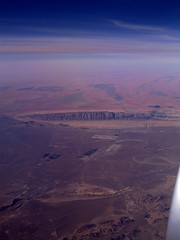 But this was the first time I’d ever seen Africa, even from the air, so my nose was pressed to the glass most of the flight.
 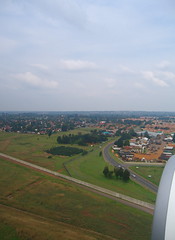 When the captain announced the initial descent, it didn’t feel like much time had passed at all. While it felt a short journey, it was obviously anything but that. The view on the left came shortly after take off, and the view on the right came just before landing. They are, literally, continents apart.
While I was looking forward to seeing Johannesburg, I was first on my way to Cape Town. I’d booked the the connecting flight with this airline. Yes, the name of the airline is Kulula.com. Now, I’m not sure why I was a bit nervous. It could have been the 1997-style web site. I might have been the fact that I never received a confirmation of my booking. Or it may well have been my inability to dissociate Kulula the Airline from Kahlúa the Drink. However, the good folks at Flyertalk.com had assured me it was a decent airline, and that I’d be happy with it. They turned out to have been quite right. In fact, the plane was actually a code-share, and it was a British Airways flight to Cape Town.
I’d snagged an exit row seat, and the flight attendant came back to give us the usual safety spiel. Well, not exactly the usual. As we got near the end of it, she explained:
“In the event of an emergency, I will direct you to the appropriate exit.”
Man in seat on other side of the aisle, having a go at her: “What if you get hurt and can’t do that?”
“Well, the other flight attendant will guide you, I’m sure.”
“What if *he’s* hurt?”
“Well, I imagine you’ll be right fucked then, won’t you?”
I decided right there that she was among my favorite flight attendants, ever.
The flight touched down in Cape Town after dark, and it had been a long day. I picked up my car, a nice little Opel Astra with a sunroof – summer in January! The airport is only a 20 minute drive outside of town. Which means that my hotel should only have been a 25 minute drive away. Should have been.
I’m generally pretty good when it comes to directions. Usually, I just need to take a quick look at a map for orientation, and I can sort it out along the way.

And really, I almost did this time. I mean, I *saw* my hotel. I just couldn’t quite get there. The Waterkant district of Cape Town is a mess of one way streets, not-quite-roundabouts, jughandles, and apparently whatever else it takes to get me almost lost after a long day of travel.  I saw hotel after hotel that I’d considered booking, but had declined. I wondered how I managed to pick the one that I could not get to. Eventually, I did find my way to the Victoria Junction Hotel (much recommended), was immediately thrilled with my pick, and found it quite easy to get a good night’s sleep.
In my head, I’d imagined my time in Cape Town to be divided like this: Cape of Good Hope, beach, Robben Island, beach, Cape Town, beach, drive through the winelands, and beach. See the theme? Well, let’s start with the first day, and see how it goes from there.
The very idea of the Cape of Good Hope excited me. The tip of Africa! So I packed up my camera, water, a bit of food, and headed on my way. Deciding to drive down the east side of the peninsula, most of the drive was along the edge of False Bay. Here, pictures are so much better than words:


I stopped in Boulder for a bit, in search of the penguin colonies I’d heard about. Future penguin hunters, this might help you:
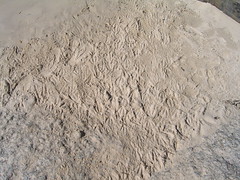
Penguin tracks. Which led me to:

Penguins. Hunted down.
Apparently unimpressed.
The drive eventually wound its way inland as the beaches gave way to cliffs. The southernmost end of the the peninsula is mostly occupied by the Cape of Good Hope Nature Reserve (R10 admission?), so the experience is really quite solitary. And after the crowds of Delhi and Bombay on this trip, I found it blessedly so.
The park road ends just near Cape Point. The Cape (which is not actually the southernmost point of Africa) branches into two parts – Cape Point, and the Cape of Good Hope. Cape Point is rather high, and as such, is home to a couple of lighthouses. You can take a funicular railway to the top, but if you do, you’re missing a beautiful walk (plus you’re a lazy bastard, to boot). It’s a fairly popular spot, so you’ll almost certainly find yourself in the company of tourists. A few shots from the top:


Less popular, and a bit more of a hike, is the path to the old lighthouse. A much less traveled path, it takes you down past some WWII fortifications  (short history lesson: nearly on the wrong side), a nifty little plaque pointing out the wreck of the Lusitania, and on down to the lighthouse itself. It’s a nice walk, and well worth the extra effort.
Now, I had a rough understanding that the Cape of Good Hope was actually lower than Cape Point, and to the west. From the parking lot, it looked like a quite a hike. However, it was a hike with some very promising scenery along the way:
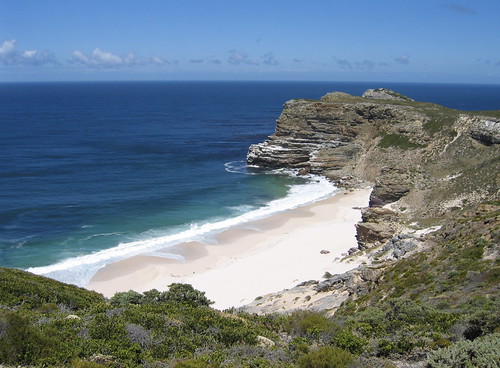
Now, if you look above that beautiful beach, you’ll see the rise that I took to be the Cape of Good Hope. It’s a good ways away from road, and I imagined that not too many folks made it out there. So I, of course, had to go. It was unthinkable to come all the way here and not have bothered for this last mile.
What followed was a very long and very hot hike. Very long. Very hot. Long. Hot.  (Huh. I guess the Internet, among other things, can serve as a reality check for whingers. I just used this tool to see if I could retrace my route and get a rough estimate of the distance. Yes, that would be less than two miles. I am standing by the Hot part, though. You can’t take that away from me.)
After a detour down the cliffs to the beach in that picture (having it all to myself, I considered never leaving), and a scramble over some rocks in increasing wind, I made it to the point. And took this shot:
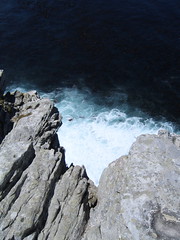
About 5 seconds later, I faced my own mortality. Really. As I was backing away from the edge, a gust of wind knocked me over, and I fell towards the edge. Ended up a few inches short of it, on my face. In Africa, you are responsible for saving yourself from your own stupidity. Not a bad approach, but it took me a few moments to come round to that judgment. (Side note: contemplating your own mortality is an excellent use of your time at what feels like the edge of the world.)
I soon discovered that I’d made another – but at least non-life-threatening, this time – mistake. Peering over the other edge of the cliff, I discovered that I wasn’t actually on the Cape. The Cape itself was further west, down another fairly steep hill. And just beyond the road. Yes, a road. With lots of people on it. Who had driven there. I took solace in the fact that at least I did it the hard way. So, with a little more resolve and bit more time, I finally made it down to the Cape of Good Hope.
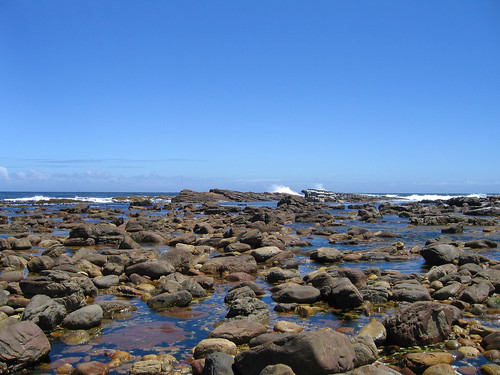
I sat on the rocks for a couple of hours. Wouldn’t you?
Feeling slightly toasty after all that time in the sun, I decided to head back to Cape Town. The drive back up the west coast of the peninsula is really quite amazing, with parts of it literally carved out of the cliffs. (Click here for a panoramic shot of Chapman’s Peak.) 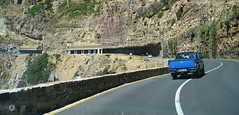
The road takes you past the 12 Apostles (a mountain range), and through some nice, if slightly overcrowded, beach towns. I briefly revisited my hosteling days when I stopped at a bar along the way and soon found myself at a table full of backpackers. Somehow, I ended up between the Dutch girls and the Australian guys. Some of you will understand what a dangerous place this can be, so I didn’t stay too long. (I did, however, later balance things out and retain my elitist cred by sharing a dining patio with Mekhi Phifer.)

The plan, formed as I drove back along the coast, was to head back to the hotel and get ready for a night on the town.  Perhaps start at a wine bar and follow the fun from there. First, though, I needed a rest. It had been a long and hot day, especially on the hike, but I gave myself a bit of a pat on the back, for having been so responsible as to buy a hat and wear a long sleeved shirt. It turned out that I was, as my grandmother often liked to say of me, too clever by half.
Sparing you the details, let’s just say that as soon as I saw myself in my hotel room mirror, I discovered that I’d badly misjudged my time in the sun. So badly, in fact, that I immediately knew that I’d be erasing the “beach” part of my plans for the rest of the week. Mad dogs and Englishmen, indeed.
Highlights from the rest of my stay in Cape Town:
Wine, wine, and more wine: No, I didn’t head into a bender to escape the pain of my skin. I simply couldn’t pass up the chance to try as many wines as possible while I was there.  South Africa has long been the source of my favorite wines, and while I wasn’t able to make it to Stellenbosch, the folks at Caroline’s Fine Wine Cellar did an excellent job of bringing it to me.
District Six Museum: Among the essential stops of any visit to South Africa. I’ll let the museum’s website tell you why:
District Six was named the Sixth Municipal District of Cape Town in 1867. Originally established as a mixed community of freed slaves, merchants, artisans, labourers and immigrants, District Six was a vibrant centre with close links to the city and the port. By the beginning of the twentieth century, however, the history of removals and marginalisation had begun. [ . . . ] In 1966, it was declared a white area under the Group areas Act of 1950, and by 1982, the life of the community was over. 60 000 people were forcibly removed to barren outlying areas aptly known as the Cape Flats, and their houses in District Six were flattened by bulldozers.
Table Mountain: Perhaps the most recognized symbol of Cape Town, Table Mountain is the major geographical feature around which Cape Town has formed.  Providing a beautiful view, it is the result of some very interesting geological forces. To get a closer look, you can climb it or take a disconcerting revolving cable car to the top (the idea is to give everyone a chance at all the views on the way, but the reality is a lot of “oh, god, make it stop moving“s along the way). I’d failed to heed the many warnings that it was cold and windy at the top, and went up in shorts. It was the middle of summer and I’d just gotten sunburned, so how cold could could it be? Well . . . very cold. Yes, I’m a little slow in the protecting myself from the elements department . . .
I’d timed the trip to put me up there for sunset, and it was worth every shiver. Next time I’ll take a cue from some of the people who shared a spot amongst the rocks with me, and bring a bottle of wine and a blanket.
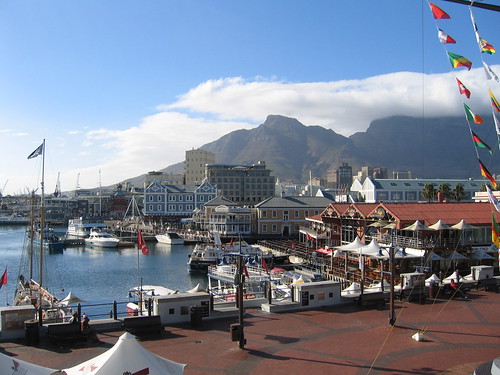
Victoria & Albert Waterfront. Not exactly the tourist trap it first appears to be, as it’s built around an actual working harbour. It’s also the place where I waited out the sun the day after my burn, when I realized that it was so bad that there could be no contact between skin and sun without a vampire moment. There are numerous galleries tucked amongst the shops (tho’ the best art is to be found in the sidestreets of Waterkant), a couple of small museums, as the home base for South Africa’s America’s Cup entry. Almost all visitors to Cape Town will end up spending at least some time at the Waterfront, if only as the port of departure for Robben Island. All in all, a beautiful place.
Robben Island, and my travels beyond, are best left for another effort (Part 4). As beautiful as South Africa was to see, it’s the human experience that made an impact and has stayed with me. I’m just not talented enough to write a single article in which I complain about a sunburn and then later tell you what it was like to stand at the door of Mandela’s cell on Robben Island.
Cape Town Travel Epherema
I found South Africa in general, and Cape Town in specific, very easy to navigate. With respect to Cape Town and Johannesburg, you can expect thoroughly modern infrastructure almost everywhere you go.
Language: You’ll not need anything but English. Everyone speaks it, and it’s not rude to assume that when addressing someone, even if you’ve just heard them speaking Afrikaans or something. That said, you’ll hear a bit of everything in the background.
Money: I collected all my South African Rand at ATMs, which are plentiful. I did find the 8 to 1 conversion a bit tricky on the fly, but I’m a little slow (I think it’s closer to 6:1, as of Jan 2007).
Telecom: Unlike most other countries I’ve been to, it’s easier (and much cheaper) to rent a SIM (for your unlocked GSM phone) than buy one. The signal quality was often crap, however, and high-speed wireless internet access can be dear. In fact, in Jan 2006, my own informal survey of Cape Town internet cafes revealed most of them to have dialup-speed connections. I blame most of this on a lack of any real competition in the telecoms sector, but that’s another post (and if you’re reading this, President Mbeki, I’m quite open to a contract to come on over there and help move that along . . . ).
Driving: Remember to drive on the left, and you’ll be fine. Highways and roads are all very well marked. I booked my car along with my domestic flight, and I got exactly what the site told me I’d get. No hidden charges, no complications.  They do take the damage liability thing very seriously, though, so when you do your walkaround of the car at pick up, be sure to note every.little.thing. When I dropped my car off, staff managed to find a few tiny little nicks and started to tell me that I’d have to pay for them. I insisted that I’d not caused them, and didn’t plan on paying for anything. After that, they only asked me to sign a form stating that I’d not caused any damage, and that was that.
Accommodations: The Victoria Junction was a quite a find. It’s apparently popular with the many film crews you can find around Cape Town.  A very nice place at a very reasonable price. And any place that advertises its own Calendar Boys in its elevators has to be good, no?
Food: Not exactly a vegetarian’s paradise, but having just come off of a long stay in India, I’m not sure anything could measure up. That said, my meal at onewaterfront was phenomenal, and I highly recommend booking dinner there (and a room, if you’re feeling flush). Green Point/Waterkant is full of lots of good places to brunch and be seen – try Andiamo if you’re feeling fab. Otherwise, the only other observation that stayed with me regarding South African food is that it all seemed a bit expensive in comparison to other things. I suspect South African cuisine will provide omnivores with a more memorable experience.

 When I first heard about the Dulles landing, I was looking around for information about any public events or viewing areas at Dulles. Finding no public events planned, I took some solace in this article, which appeared to indicate a couple of daytime opportunities to see the plane land or take off. Unfortunately, that schedule seems to have changed. I called the Dulles Public Affairs office to ask about landing times, and they told me that the schedule has been changed to have the plane arrive late Sunday, and depart late Monday night, scrapping any chance of a daytime viewing. So while you might be able to catch a brief glimpse of the landing lights, any trip out to Dulles to see an A380 will almost certainly be disappointing.